GLOCAL June Newsletter: New Rules, New Players, New Opportunities
Hi there!
June was packed. Here’s what we were up to and what caught our attention across the AgriFoodTech world.
Key Takeaways from São Paulo
June brought the AgriFoodTech community to São Paulo, and GLOCAL was in the middle of it! Three intense days of conversations with entrepreneurs, investors, corporates, and ecosystem leaders.
For GLOCAL, the week kicked off with the Demo Day we organized for Corteva Catalyst, where the Corteva team met with a selected group of promising startups. It was a great opportunity to exchange ideas on innovative technologies and discuss their path toward commercial adoption.
During World Agri-Tech, GLOCAL Founder & Managing Partner Bernardo Milesy joined the panel “Rethinking AgTech Funding: Aligning Venture, Private Equity, and Public Finance with Commercial Adoption.”
At the same summit, GLOCAL Partner & CFO Beatriz Ponce de León led the roundtable “Accelerating Adoption: Bridging the Gap Between Tech Innovators and Farmers”.
We also took part in SP Ventures‘ Harvesting Innovation event and the Women in AgTech Breakfast.
Glocal Game Changers is Open and Growing Fast
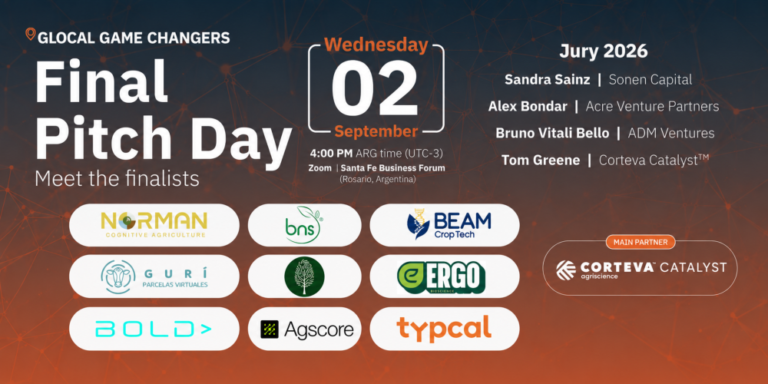
We’ve already received over 200 applications from Argentina, Brazil, Colombia, Mexico and beyond🚀, and the program is still open through the end of July.
If you’re building in AgriFoodTech or ClimateTech and looking for the right partner to scale, this is your window. Apply now →
Beyond São Paulo, June kept us on the move across the Americas:
📌Bernardo Milesy joined the ARCAP “Asado” Meetup (Buenos Aires, Argentina)
📌 Beatriz Ponce de León joined the panel “How Do Investors Evaluate Impact Pitches?” at Tech for the Planet (Montevideo, Uruguay), an event organized by ClimaTech Argentina, Antom.la, ARCAP and URUCAP.
📌Beatriz Ponce de León hosted the AgriFoodTech session at the Argentina Tech Hub (New York, USA)
💼From Our Portfolio
ZoomAgri’s New Device Is Redefining Grain Quality Control
ZoomAgri has just launched its most advanced device yet, using high-resolution cameras and physical AI to automate on-site evaluations of grain and oilseed quality, processing significantly larger samples in just minutes. Already adopted by major agribusiness players across Argentina, Brazil, Australia, France, and Canada, ZoomAgri is rapidly expanding its global footprint with the US and other markets coming next.
Watch video here
microTERRA Strengthens Its Commercial Foundation
The Mexican biotech recently launched a new website and updated commercial materials, sharpening how it communicates its value proposition to customers, partners, and investors. It also signed strategic distribution agreements to expand its commercial reach through experienced market partners, while continuing to advance pilot projects and secure recurring customer orders, reinforcing its foundation for revenue growth and broader market adoption.
Ucrop.it Takes the Stage at the Leading Biofuels Event in the US
Marcos Botta, Co-founder and Chief Innovation & Operations Officer at Ucrop.it, spoke at the International Fuel Ethanol Workshop & Expo (FEW) in St. Louis, contributing to key conversations around low-carbon fuels and sustainable feedstock programs. A consistent theme across sessions was that the 45Z tax credit is pushing the industry to move from assumptions to evidence, making field-level data capture, traceability, and audit-ready compliance increasingly critical across the biofuel value chain. With over 70 million verified acres globally, Ucrop.it is well positioned to help producers and industry players meet these growing demands.
Elisa Bertini Receives the Rotary Young People for Excellence Award 2026
Congratulations to Elisa Violeta Bertini, co-founder of Puna Bio, on receiving the Rotary Young People for Excellence Award 2026 in the Entrepreneur category. This recognition highlights her commitment to innovation, impact creation, and the belief that science can transform the future of agriculture. At Glocal, we’re proud to have her leading the way and this award is a well-deserved reflection of everything she and the Puna Bio team are building. Congratulations, Eli! 🏅
📰Industry Highlights
Brazil’s “AgroValley”: A New AgTech Ecosystem Takes Shape in Mato Grosso do Sul
VivaTerra Ventures launched its first fund in June with the goal of raising R$150 million in six months to invest in early-stage AgTech startups in robotics, AI, and biotech, built around AgroValley MS, an innovation ecosystem developed in partnership with the state government, Fundação MS, and a local university. A deliberate attempt to bring Silicon Valley-style venture infrastructure to one of Brazil’s most productive agricultural states.
The Argentine Startup Ecosystem Is Back on the Radar
Local startups raised over $427 million in the first months of 2026, already surpassing the $270 million raised across all of 2025, driven by larger rounds in mature companies — led by Ualá ($195M), Humand ($66M), and Pomelo ($55M) — with Biotech, Fintech, and AgTech leading the number of transactions. A relevant signal for the regional ecosystem: international funds that had pulled back from Latin America are returning, with bigger tickets and a sharper focus on AI applied to high-friction markets.
A Major Setback for Plant-Based and Cultivated Meat in Europe
The European Parliament voted to ban meat-related terms — like steak, liver, or tenderloin — from plant-based and cultivated food products, and explicitly excluded cell-based products from using the designation “meat.” A costly signal for the sector: rebranding and packaging adjustments could run up to €250 million for Germany’s plant-based industry alone.
Another EU Regulation to Watch: A Green Light for New Genomic Techniques
In the same week, the European Parliament also moved on a very different front for the agrifood sector. The EU formally adopted rules on New Genomic Techniques (NGTs), splitting NGT-altered plants into two categories: NGT-1, treated like conventional plants for limited modifications, and NGT-2, subject to existing strict GMO rules and risk assessments before commercialization. The regulation is expected to facilitate access to crops that are more climate and pest-resistant, require fewer pesticides, and deliver higher yields.
A $400M Bet on Argentina: One of the World’s Largest Sunflower Processing Plants Is Coming
Louis Dreyfus Company announced a $400 million investment to build a new sunflower and soybean processing plant in Bahía Blanca, set to become one of the largest sunflower crushing facilities in the world, and described by the company’s global CEO as one of the most significant investments in Argentina’s agro-industrial sector in the last decade. A strong signal of confidence in the country’s agricultural potential from one of the world’s largest commodity traders, at a time when Argentina is actively seeking to attract large-scale foreign investment.
Chile Opens the World’s Southernmost Hazelnut Processing Plant
Grupo Hijuelas and Nefuen inaugurated a European hazelnut processing facility in Osorno (the southernmost of its kind in the world) integrating the full production chain from reception to export preparation in a single location. A concrete example of Latin America moving up the value chain in specialty crops: Chile already leads European hazelnut production in the Southern Hemisphere and could become the world’s largest producer of the variety by 2035.
A Chilean Biotech Tool to Detect Powdery Mildew in Vineyards Before It’s Too Late
Researchers at Universidad de Concepción, supported by Chile’s Foundation for Agricultural Innovation (FIA), are developing DOVI — a molecular diagnostic kit based on LAMP technology that can detect the presence of Erysiphe necator (powdery mildew) directly in the field, without specialized labs or highly trained personnel. The team has already validated a functional prototype at laboratory level and is currently in the commercial validation stage, in collaboration with startup Green Focus Solutions. A relevant example of how Latin American academic research is translating into practical, accessible AgTech tools for producers.
🔎 Featured AgriFoodTech & ClimateTech Rounds and Deals
Molinos Río de la Plata Acquires NotCo’s Operations in Argentina and Uruguay
Argentina’s largest food company acquired the local and Uruguayan operations of NotCo (the Chilean AI-powered plant-based food unicorn backed by Jeff Bezos, Roger Federer, and funds like Tiger Global and Kaszek) in a move that brings Molinos into the fast-growing plant-based nutrition category. Founded in 2015 and valued at over $1.5 billion, NotCo uses an AI algorithm to develop meat and dairy alternatives, with 130 products already on the market and revenues estimated at $75 million after growing 300% in 2025.
From the Atacama Desert to the Farm: A Chilean Biotech Bet on Extremophile Microorganisms
Ayni Desert Interaction, a Chilean biotech startup, secured funding from ANID’s Startup Ciencia 2026 program to develop bioinputs from Atacama Desert microorganisms — organisms uniquely adapted to drought, salinity, and extreme conditions — to strengthen crops in adverse environments. Still at early validation stage (TRL 4) and working with Universidad Católica del Norte, the company is a signal that Latin American biodiversity is becoming a source of proprietary AgTech with real commercial potential.
A $25M Venture Arm to Back Animal Health Startups
One of the industry’s largest global players is stepping into early-stage investing: Elanco Animal Health announced the launch of Elanco Ventures, a dedicated CVC platform backed by a $25 million multi-year commitment, targeting Pre-Seed through Series A companies advancing therapeutics and technologies in animal health. A relevant signal for founders and investors in the AgriFood and animal health space.
Anthropic Joins a $915M Bet on Carbon Removal
Frontier’s advance market commitment platform (backed by Stripe, Google, Shopify, Salesforce, and H&M Group) announced an additional $915 million for carbon removal companies, bringing its total to $1.8 billion, with Anthropic joining as a new buyer for the first time. A notable signal for the ClimateTech space: one of the world’s leading AI companies is putting real weight behind carbon removal. The new “Growth AMC” will focus on 10–15 concentrated bets through 8- to 10-year offtake agreements, prioritizing technologies with gigaton-scale potential and a clear path to long-term policy-driven demand.
Insect Ag Enters a New Phase: $59M for Innovafeed as the Sector Matures
French black soldier fly firm Innovafeed raised $59M and consolidated operations at its commercial-scale facility in Nesle, France, cutting 60 R&D positions as it shifts from development to full industrial production. Since its $250M Series D in 2022, production volumes have increased tenfold while costs dropped by seven times — with revenues doubling each year in aquaculture and pet food. A signal that the insect ag sector, after a wave of bankruptcies, is entering a phase where scale and unit economics matter more than R&D ambition.
Cultivated Meat Consolidates: UPSIDE Foods Bids $50M for Believer Meats’ Facility
UPSIDE Foods submitted a $50 million stalking horse bid for the US assets of distressed cultivated meat firm Believer Meats, including its large-scale production facility in Wilson, North Carolina — a site that received over $150 million in investment and holds USDA and FDA approvals. Believer Meats, which had raised nearly $400 million from backers including ADM Ventures and Tyson Ventures, ceased operations in December and was put into receivership in early February. Other bidders have until July 20 to submit competing offers — a sign that even as the cultivated meat sector struggles, its infrastructure is attracting strategic interest rather than simply going to waste.
🍎Food for thought
Feeding 10 Billion People Will Require a New Technological Revolution in Agriculture
According to AgFunder data, global investment in agricultural innovation surpassed USD 16 billion in 2025, driven by growing pressure from climate change, food volatility and resource scarcity. Startups are accelerating breakthroughs in biologicals, AI-driven precision agriculture, genetic improvement and climate-resilient crops as the industry moves toward a new era of data-intensive farming (from The Economist).
AgTech Investment Through a Buffett Lens
Michael Lee, Managing Director at Syngenta Group Ventures, lays out the mental “algorithms” that should guide venture capital investment in agtech, drawing comparisons with biotech and public markets to argue for more disciplined valuations and realistic exit expectations. The core argument: agtech’s structurally smaller market, limited buyer pool, and near-exclusive reliance on M&A exits demand conservative valuation assumptions at every round, and inflated intermediate valuations tend to be toxic to early-stage companies. Worth reading for anyone deploying or raising capital in the sector.
The AI Boom’s Hidden Cost: A Signal to Watch for AgriFood
Across the American West, ranchers and farmers are raising growing concerns about the expansion of large-scale data centers over water, as AI infrastructure competes directly with agriculture for one of its most critical and finite resources. Researchers from the University of Texas at Austin warn that data centers could account for 3% to 9% of Texas’s total water use by 2040, with more than 400 facilities already operating or under construction in the state alone. A relevant tension for the AgriFood sector to monitor: the same AI boom driving innovation in precision agriculture is also creating new pressures on the land and water systems that farming depends on.
Thanks for reading. As always, if any of these topics resonate, we’d love to hear from you.